Teaching AI to Sort Canal Waste with Only a Few Labels
Canals carry more than water. They also carry bottles, bags, and many other kinds of waste, usually piled together, partly hidden, and photographed under changing light. Teaching a computer to recognize every type of waste in such a scene normally requires people to label thousands of images by hand. That work is slow and expensive, and it is one of the main reasons why waste monitoring tools are still rare.
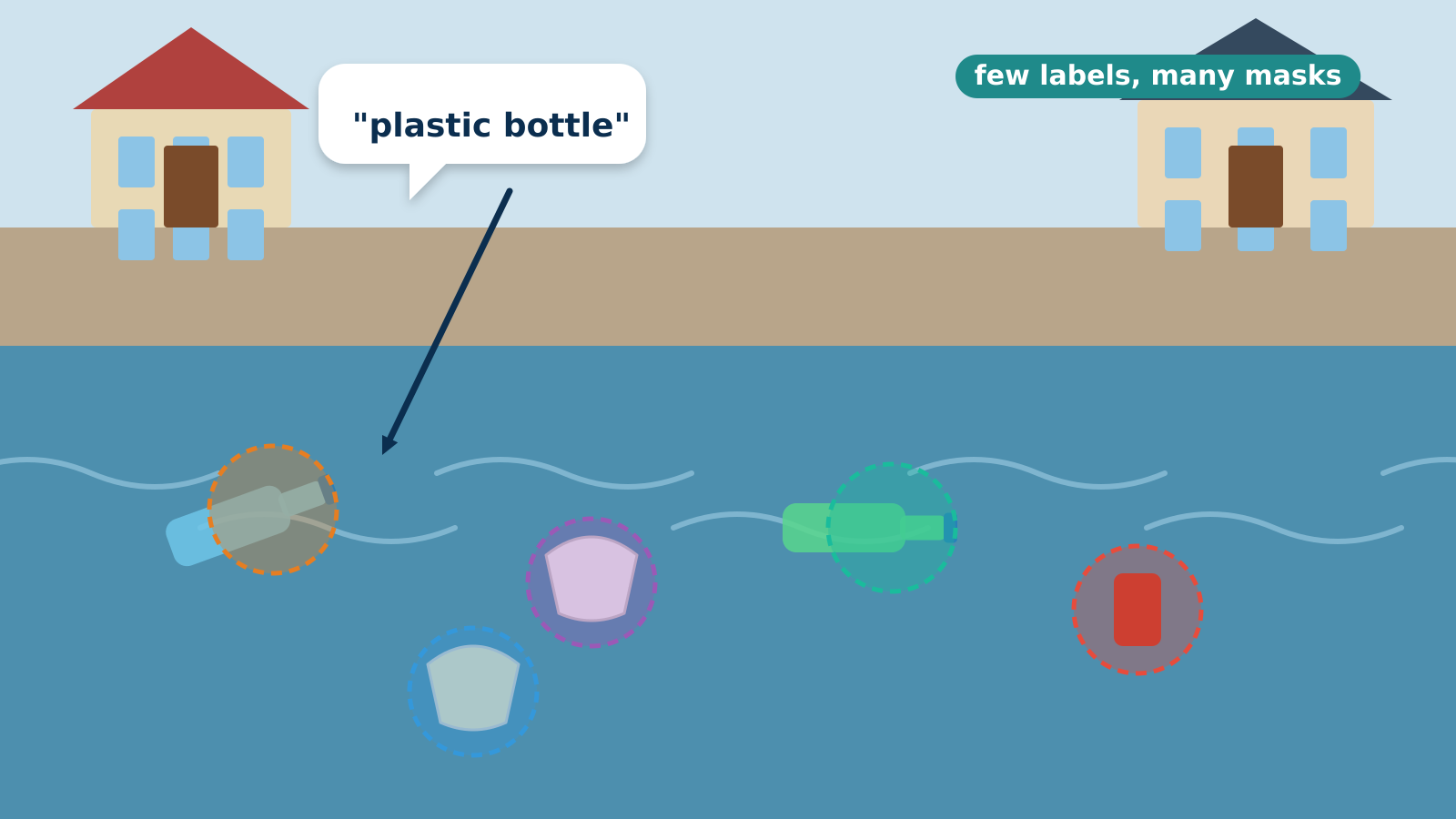
This study reduces that burden with a framework called TGS. The idea is to let people label only a small set of images and let the computer take care of the rest. A ConvNeXt-Tiny classifier is first trained on the small set of labeled images. It then looks at unlabeled images, and the labels it is confident about become text prompts for Grounding DINO, a model that finds regions in an image matching a written description. The Segment Anything Model then turns those regions into precise masks that outline each piece of waste.
What makes the method different is how it decides which automatic labels to trust. Many approaches rely on the model’s confidence alone, but a confident model can still be wrong. TGS instead checks the masks for evidence in the image itself, so a label is accepted only when the picture supports it. This extra check makes the automatically generated labels more reliable.
The team tested the method on a canal dataset from Makassar with 855 images, 18 classes, and 2,662 waste instances, of which 769 images remained after quality control. With only 10% of the images labeled by people, the method reached a micro-F1 of 0.9393, ahead of FixMatch at 0.9036 and level with simple self-training at 0.9376, while being more reliable. With 20% labeled data it reached 0.9581, close to the 0.9896 achieved when all the labels are available.
This work connects to Sustainable Development Goal 11 (SDG 11): Sustainable Cities and Communities. Cheaper labeling makes it more realistic to build waste monitoring tools for the canals that run through a city, and that in turn supports cleaner waterways and better urban management.
Ultimately, this research shows that a computer can learn a great deal from a small amount of human effort, as long as it is taught to question its own guesses. That makes AI for environmental monitoring more affordable and easier to bring into real cities.
Metadata:
Judul article: Vision-Language Guided Pseudo-Labeling for Multi-Label Waste Classification
Nama jurnal: International Conference on Current Research in Artificial Intelligence and Data Science (ICCRAIDS)
Penerbit: IEEE
Tanggal publish: April 2026
Tautan / Link: https://doi.org/10.1109/iccraids67816.2026.11519578
Contact:
Prof. Dr. Ir. Indrabayu, S.T., M.T., M.Bus.Sys., IPM., ASEAN.Eng
0811447755
indrabayu@unhas.ac.id