Reading Plates After Dark: Sharper Low-Light Detection for Traffic Cameras
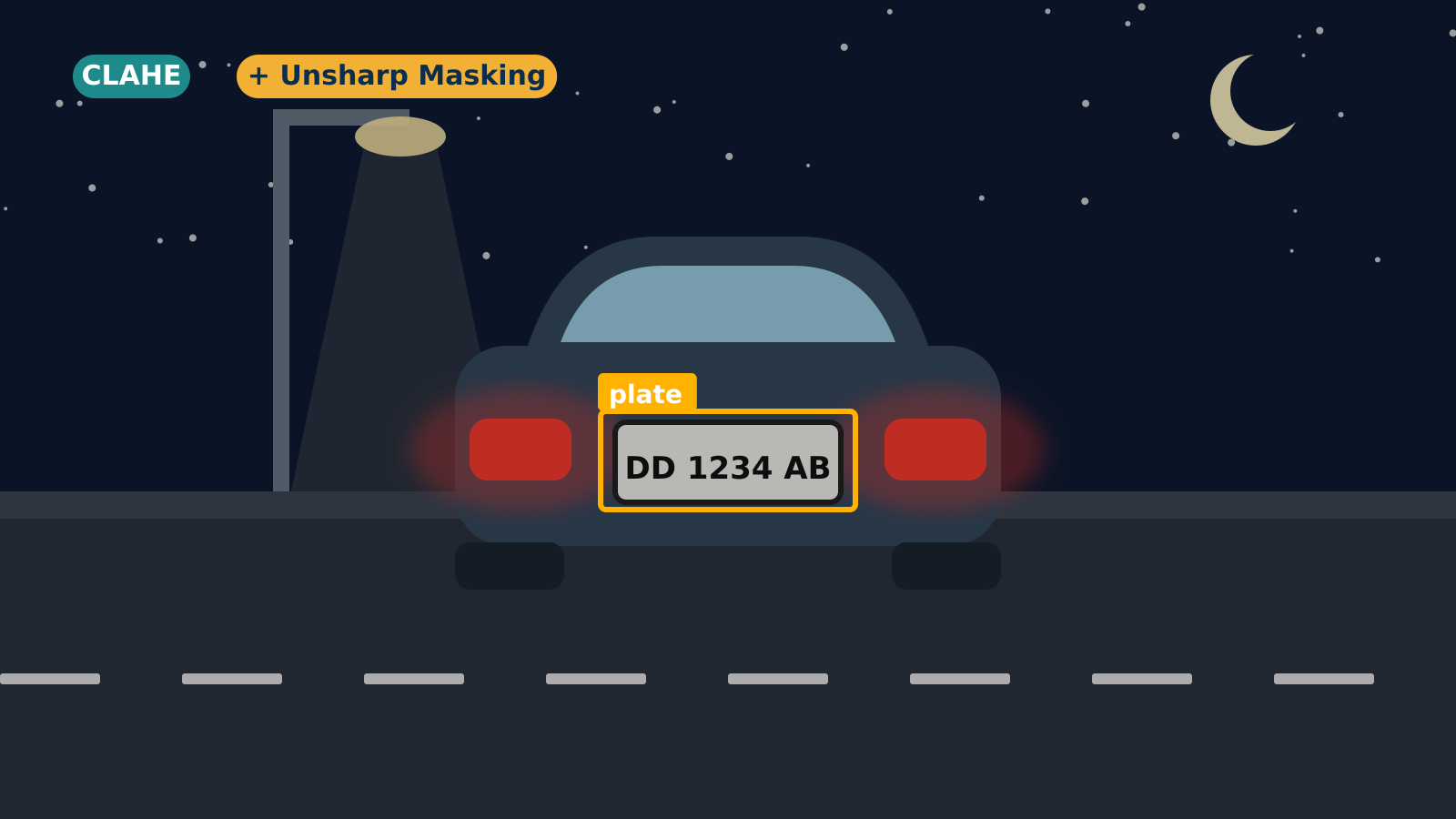
Traffic cameras are only useful if they can read what they see, and a license plate is especially hard to read at night. When the light is poor, plates turn dark and blurry, and systems that work well in the day start to fail. As the number of vehicles keeps growing, checking traffic by hand is neither efficient nor reliable, which is why automatic plate recognition matters for traffic management and law enforcement.
Recognizing a plate involves several steps, and the very first one is finding where the plate is in the image. If that step fails, nothing that follows can work. This study focuses on improving exactly that first step under low light. The researchers enhance the images in two stages before they reach the detector, so that the plate stands out more clearly from the dark background.
The two stages each have a different job. CLAHE boosts contrast locally, which brings out details in dark regions without washing out the rest of the image. Unsharp Masking then sharpens edges, which helps counter the blur that makes characters hard to separate. The enhanced images are passed to the YOLOv11 detector. The dataset has 1,496 images taken from Electronic Traffic Law Enforcement (ETLE) video in Makassar, divided 70:20:10 into training, validation, and test sets.
Four experimental scenarios were used to see what each enhancement contributes on its own and in combination. Using CLAHE and Unsharp Masking together gave the best results, with a precision of 0.945, a recall of 0.977, and a mAP@0.5:0.95 of 0.830, ahead of every other setup. The authors conclude that the combination makes plate detection clearer and more dependable in low light, and practical for real intelligent transportation applications.
This work connects to Sustainable Development Goal 11 (SDG 11): Sustainable Cities and Communities. Traffic systems that keep working after dark are a step toward better managed roads in growing cities, where monitoring needs to continue around the clock rather than only in good light.
Ultimately, this study shows that a careful preparation of the image can matter as much as the detector itself. A little help with contrast and sharpness lets traffic cameras keep doing their job when the sun goes down.
Metadata:
Judul article: An Improvement of License Plate Detection Under Low Light Condition Using CLAHE and Unsharp Masking
Nama jurnal: International Journal of Engineering Science and Information Technology
Penerbit: Association for Scientific Computing Electronics and Engineering (ASCEE)
Tanggal publish: December 2025
Tautan / Link: https://doi.org/10.52088/ijesty.v5i4.1654
Contact:
Prof. Dr. Ir. Indrabayu, S.T., M.T., M.Bus.Sys., IPM., ASEAN.Eng
0811447755
indrabayu@unhas.ac.id