Knowing the Visitors: Smarter Segmentation for a Nature Park
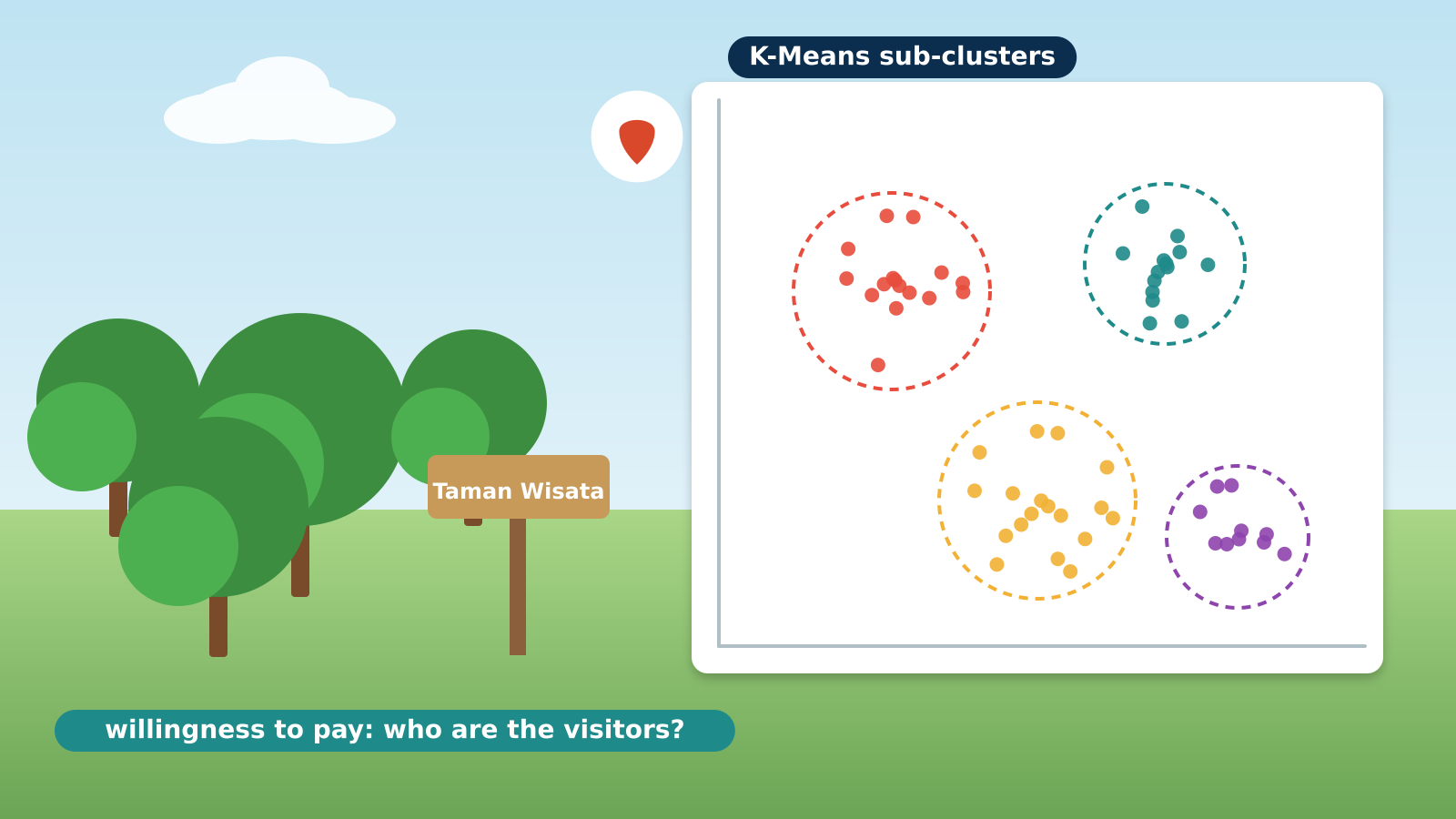
Who visits a nature park, and what would they be willing to pay? The managers of Taman Wisata Alam Lejja had already studied visitors’ willingness to pay, and wanted to take the next step: grouping visitors into segments on that basis. Good segments help choose target markets, optimize revenue, allocate marketing spending, shape the next strategy, and design services and products that fit each group.
The researchers used K-Means clustering, a method that automatically sorts data into groups of similar items, to make those segments more accurate. To find the best approach, they compared conventional clustering with K-Means sub-clustering, which divides each cluster further into smaller, more detailed groups. The study used 1,000 records with 16 variables, and the models were evaluated with silhouette scores, ANOVA, Tukey HSD, and how easy the results are to interpret.
Conventional clustering gave silhouette scores of 0.47 for three clusters and 0.37 for eight. Within clusters 0, 1, and 2, the sub-clusters scored 0.45, 0.44, and 0.39. The ANOVA test showed that clustering with sub-clusters had significantly less variation than clustering without them, which means the visitors inside each group were more alike.
The sub-cluster approach also offered a simple interpretation, which matters for managers who need to turn the results into decisions and not just statistics. The authors conclude that sub-clustering groups the data better than the conventional method.
This work connects to Sustainable Development Goal 8 (SDG 8): Decent Work and Economic Growth. Understanding visitors better helps a nature tourism site plan its services and its revenue, which supports the people and communities that depend on tourism.
Ultimately, this study shows that looking more closely at the groups inside a group can reveal who a park’s visitors really are, and helps managers offer each of them a better experience.
Metadata:
Judul article: Comparison of Conventional Clustering and Clustering with K-means Sub-cluster in Tourist Visitor Segmentation
Nama jurnal: Advances in Electrical and Computer Technologies (Book Chapter)
Penerbit: CRC Press (Taylor & Francis)
Tanggal publish: May 2025
Tautan / Link: https://doi.org/10.1201/9781003515470-39
Contact:
Prof. Dr. Ir. Indrabayu, S.T., M.T., M.Bus.Sys., IPM., ASEAN.Eng
0811447755
indrabayu@unhas.ac.id