How Far Can a Near-Infrared Camera Still Recognize a Face?
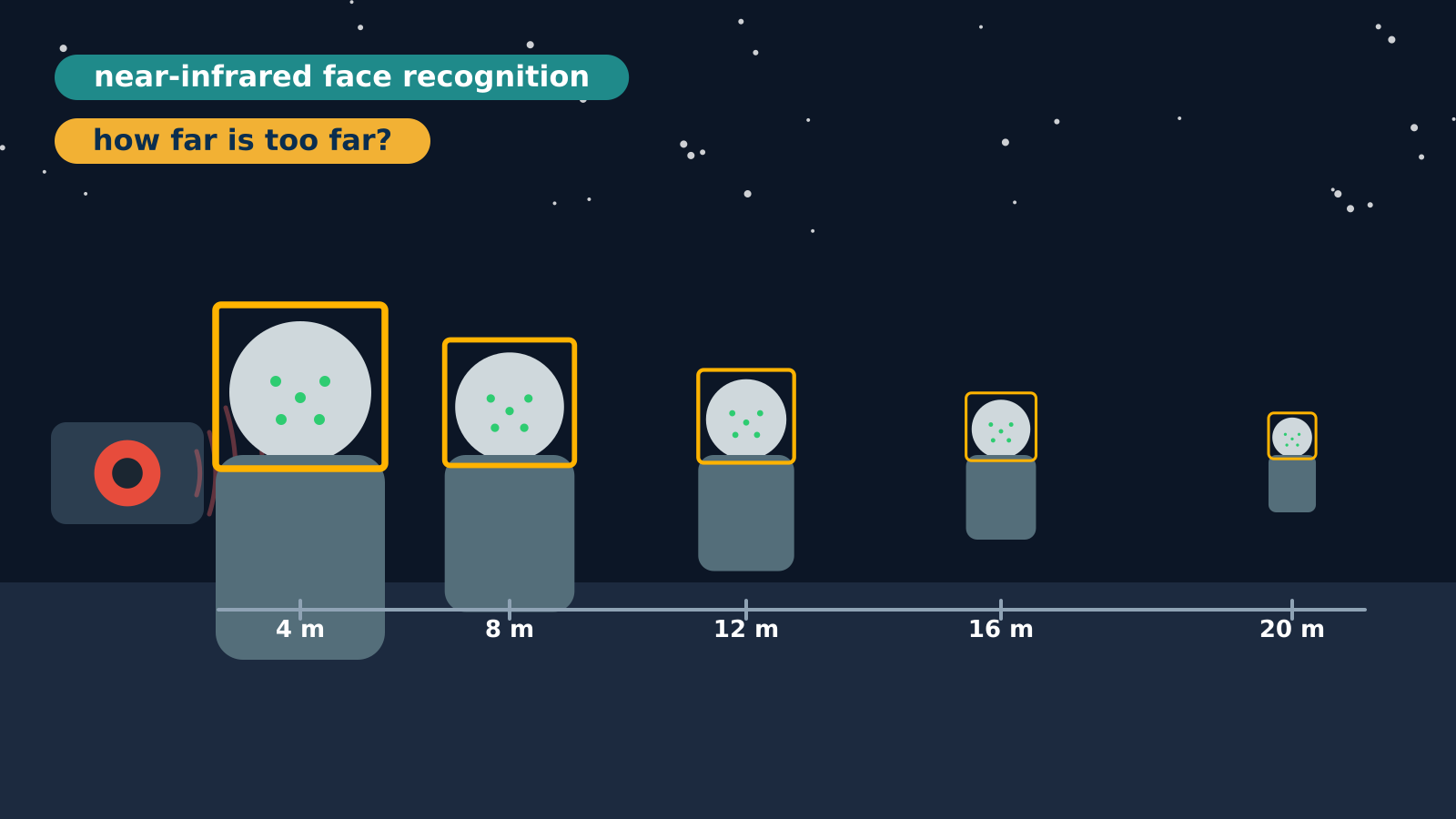
Near-infrared cameras let face recognition work in low light, even in the dark, which makes them attractive for security and access control. But every camera has its limits, and an important practical question is how far from the camera a person can be before the system can no longer be trusted to identify them.
This study set out to measure that limit. The team photographed 10 people at five distances, from 4 to 20 meters, and built a full deep learning pipeline. Selective contrast enhancement was added to MTCNN, a popular face detector, to help it find faces at a distance. Recognition used an InceptionResNetV2 model trained with triplet loss, a training method that teaches the model to place images of the same person close together and images of different people far apart. This was compared with a classical LBP+LDA baseline.
Adding selective contrast enhancement gave the best face detection rate, 76.22%. The InceptionResNetV2 model reached about 80% overall identification accuracy and clearly beat the baseline. Distance mattered a great deal: accuracy fell from 93% at close range to 55% at 20 meters.
The authors attribute the drop to the limits of low-resolution face recognition, since a face far from the camera is made up of very few pixels. For future work they suggest super-resolution, which can sharpen small images, and lightweight models for edge devices, which could make such systems more practical to deploy.
This work connects to Sustainable Development Goal 9 (SDG 9): Industry, Innovation and Infrastructure. Knowing where a recognition system stops working is as useful to engineers as knowing where it works well, because it allows them to design and deploy systems with realistic expectations.
Ultimately, this research shows that honest measurements of a system’s limits are a valuable contribution in themselves. They help ensure that face recognition is used where it can be relied upon.
Metadata:
Judul article: Operational Limits of Near-Infrared Face Recognition: The Critical Impact of Distance on Identification Accuracy
Nama jurnal: Proceedings of the 1st International Conference on Research and Innovations in Information and Engineering Technology
Penerbit: SCITEPRESS – Science and Technology Publications
Tanggal publish: 2025
Tautan / Link: https://doi.org/10.5220/0014269200004928
Contact:
Prof. Dr. Ir. Indrabayu, S.T., M.T., M.Bus.Sys., IPM., ASEAN.Eng
0811447755
indrabayu@unhas.ac.id