A Phone That Sees the Steps: Stair Detection for People with Visual Impairment
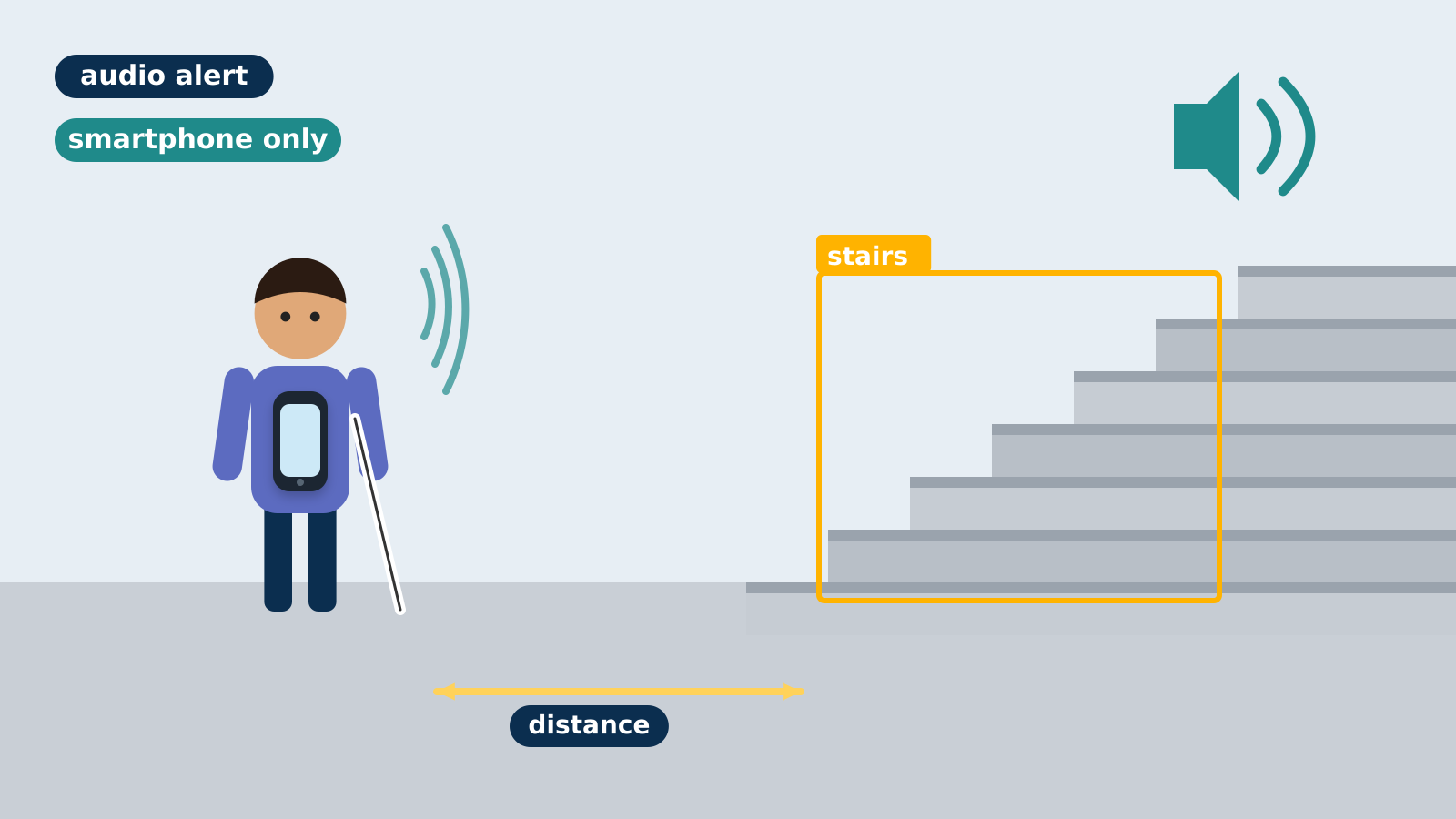
For most people a staircase is just part of a building. For someone who is visually impaired, it can be a serious risk. A missed step can lead to a fall, and many people with visual impairment have to rely on others or on expensive equipment to move around safely.
This study developed an Android application that detects stairs in real time and estimates how far away they are. It combines a MobileNet-based Single Shot Multibox Detector, a compact model that can run on a phone, with a pinhole camera model that uses the geometry of the camera to calculate distance. Data were collected with a smartphone worn on the chest, at distances from 2 to 5 meters, which imitates how a user would actually carry the device while walking.
Stairs going up were detected with an average accuracy of 98.91% at 2 meters, 99.24% at 3 meters, 99.42% at 4 meters, and 96.14% at 5 meters. Stairs going down were harder, averaging 84.63%, which is understandable because a descending staircase looks very different from the camera’s point of view. Distance estimates were off by only 0.08 to 0.24 meters.
The system needs only a smartphone, is inexpensive, and gives audio alerts, so the user receives the warning without needing to look at a screen. The authors argue that it could meaningfully improve mobility, awareness, and safety for visually impaired users.
This work connects to Sustainable Development Goal 10 (SDG 10): Reduced Inequalities. A tool that runs on an ordinary phone is one way to put assistive technology within reach of more people, rather than limiting it to those who can afford specialized devices.
Ultimately, this research shows that the phone in a person’s pocket can be turned into a pair of watchful eyes. Technology that warns of a step ahead can give people more confidence to move independently.
Metadata:
Judul article: Real-time Stairs Detection and Distance Estimation System Based on Android for Visually Impaired
Nama jurnal: IEEE International Conference on Artificial Intelligence and Mechatronics Systems (AIMS)
Penerbit: IEEE
Tanggal publish: May 2025
Tautan / Link: https://doi.org/10.1109/aims66189.2025.11229605
Contact:
Prof. Dr. Ir. Indrabayu, S.T., M.T., M.Bus.Sys., IPM., ASEAN.Eng
0811447755
indrabayu@unhas.ac.id