Fewer Tests, Same Answer: Checking Drinking Water with Fewer Measurements
Safe drinking water cannot be taken for granted. Water treatment requires regular measurements, often every hour, to confirm that the water meets drinkability standards, and every measurement has a cost in equipment, time, and effort. If some of those measurements are not really necessary, dropping them could make regular monitoring much cheaper.
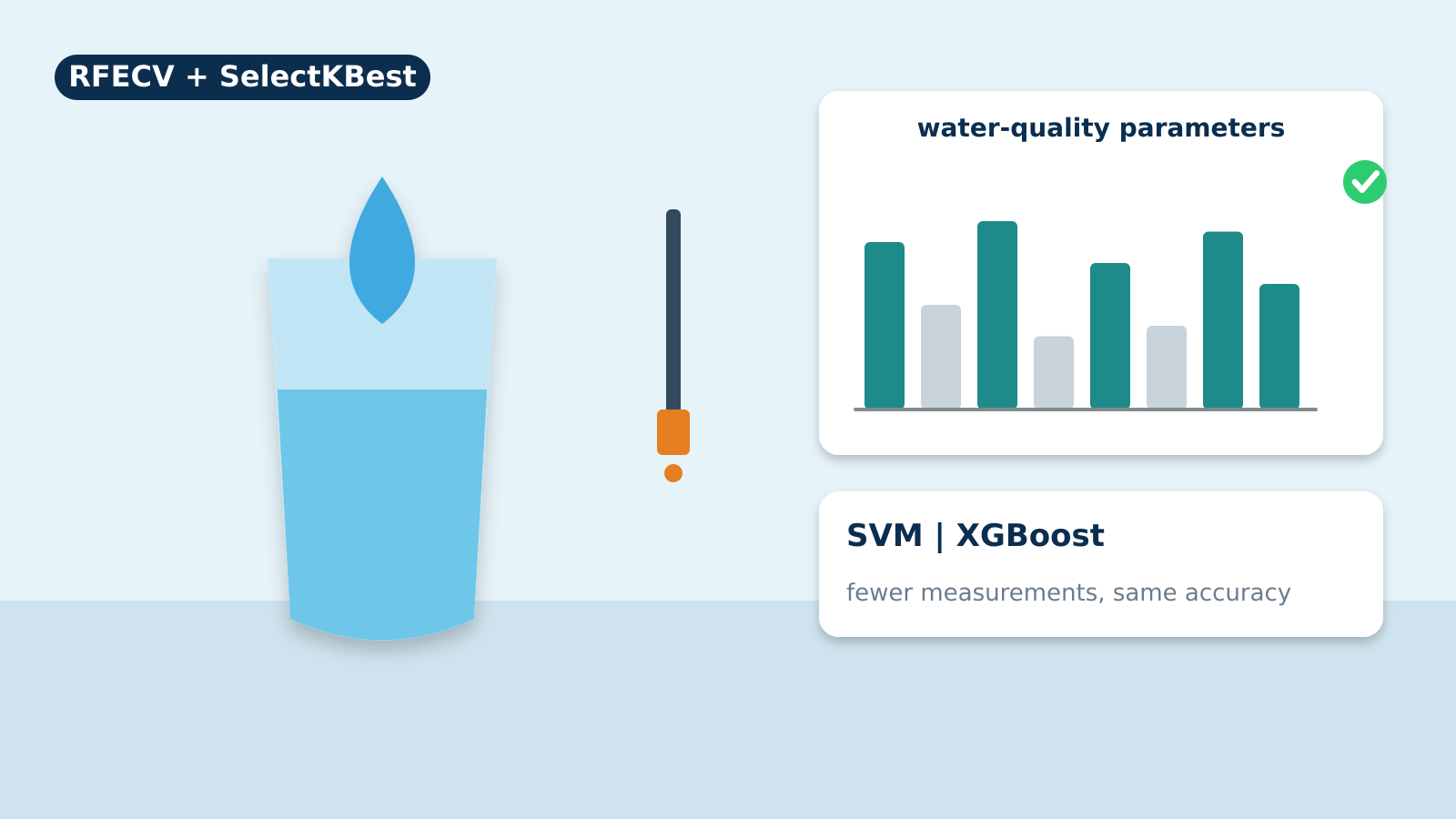
This study classifies water potability in Gowa, which means deciding whether water is safe to drink, and asks a practical question: which measurements are really needed? It uses two classifiers, Support Vector Machine and XGBoost, together with two feature selection methods, RFECV (recursive feature elimination with cross-validation) and SelectKBest. Feature selection is a way of identifying which measurements carry the most useful information and which can be set aside.
The correlations between the individual parameters and potability turned out to be weak. This is an interesting finding, because it suggests that each parameter contributes independently and carries information of its own, rather than several measurements simply repeating one another.
Before selection, the models reached 95.8% accuracy for SVM and 97.8% for XGBoost. After selection, SVM kept about 96% accuracy with five features, and XGBoost kept 97.8%. Reducing the number of parameters therefore lowers the computational and monitoring cost while preserving accuracy, and XGBoost performed slightly better than SVM.
This work connects to Sustainable Development Goal 6 (SDG 6): Clean Water and Sanitation. Monitoring that costs less to run makes it easier to keep checking water quality regularly, and regular checking is what keeps drinking water safe.
Ultimately, this research shows that doing more is not always better. By measuring only what matters, water quality monitoring can become cheaper without becoming less trustworthy.
Metadata:
Judul article: Water Potability Classification System: Regular Water Monitoring Computational Cost Reduction by Utilizing Recursive Feature Elimination with Cross-Validation and SelectKBest for Feature Reduction
Nama jurnal: Journal of Ecohumanism
Penerbit: Transnational Press London
Tanggal publish: January 2025
Tautan / Link: https://doi.org/10.62754/joe.v4i1.6103
Contact:
Prof. Dr. Ir. Indrabayu, S.T., M.T., M.Bus.Sys., IPM., ASEAN.Eng
0811447755
indrabayu@unhas.ac.id