Ripe Without a Cut: Predicting Papaya Maturity with Near-Infrared Light
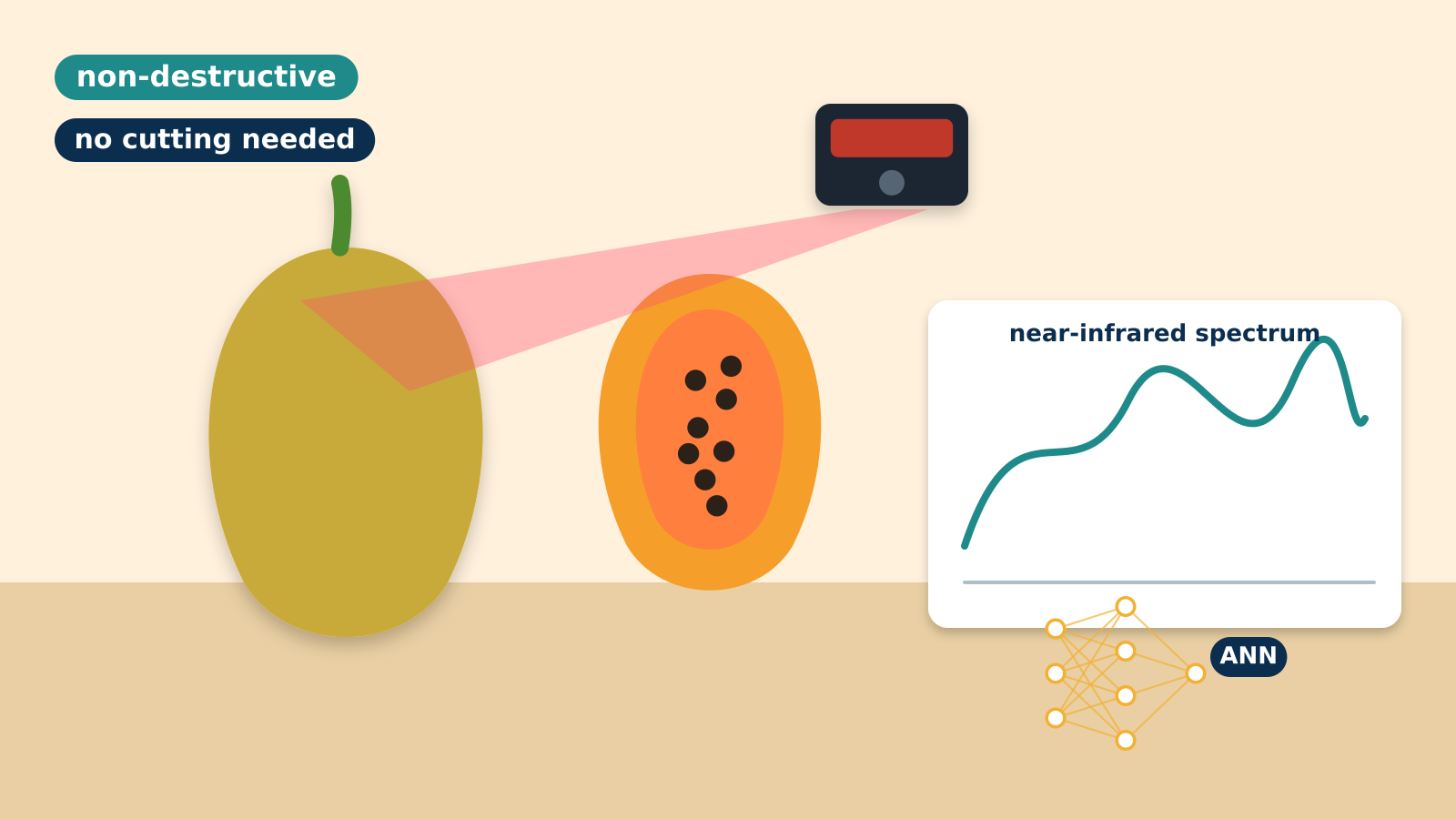
Choosing a papaya at the right moment usually means cutting into it. The common way to measure maturity in a laboratory, with a refractometer, is destructive: it damages the fruit and limits how useful the method can be for consumers and for anyone who needs to check many fruits along the supply chain.
This study looks for a gentler way using near-infrared light. When near-infrared light shines on a fruit, the way it is reflected carries information about what is inside. The team used this to predict soluble solid content, an indicator of how mature the fruit is, from the near-infrared reflectance spectra of 49 papaya samples. No fruit needs to be opened to take the measurement.
Raw spectra are noisy, so the data were first smoothed and differentiated with Savitzky-Golay preprocessing, which makes the useful patterns stand out. A nonlinear artificial neural network was then fitted to learn the relationship between the spectra and the soluble solid content. The second-derivative spectra gave the best results among the preprocessing options that were tried.
The model reached an R2 of 0.9063 in training and 0.8768 in testing, with RMSE values of 0.4406 and 0.7047. These numbers show that the model captured most of the variation in maturity and also held up on samples it had not seen during training. The authors argue that portable near-infrared systems could support real-time maturity classification in agricultural and supply chain settings, without damaging a single fruit.
This work connects to Sustainable Development Goal 2 (SDG 2): Zero Hunger. Checking fruit quality without cutting it open supports better handling of food along the supply chain, and that helps reduce waste from fruit that is picked or sold at the wrong time.
Ultimately, this research shows that light and a trained model can tell us how ripe a fruit is without leaving a mark on it. That is good news for growers, sellers, and anyone who wants a sweet papaya.
Metadata:
Judul article: Non-Destructive Prediction of Papaya Maturity Level Using Near-Infrared Spectroscopy and Artificial Neural Network
Nama jurnal: Journal of Tomography System and Sensor Application
Penerbit: [Perlu dikonfirmasi di situs jurnal]
Tanggal publish: November 2025
Tautan / Link: [Tautan DOI belum tersedia; mohon dicarikan alamat artikelnya di situs jurnal]
Contact:
Prof. Dr. Ir. Indrabayu, S.T., M.T., M.Bus.Sys., IPM., ASEAN.Eng
0811447755
indrabayu@unhas.ac.id