A Closer Look at Chili Fields: Detecting Thrips and Gemini Virus from the Air
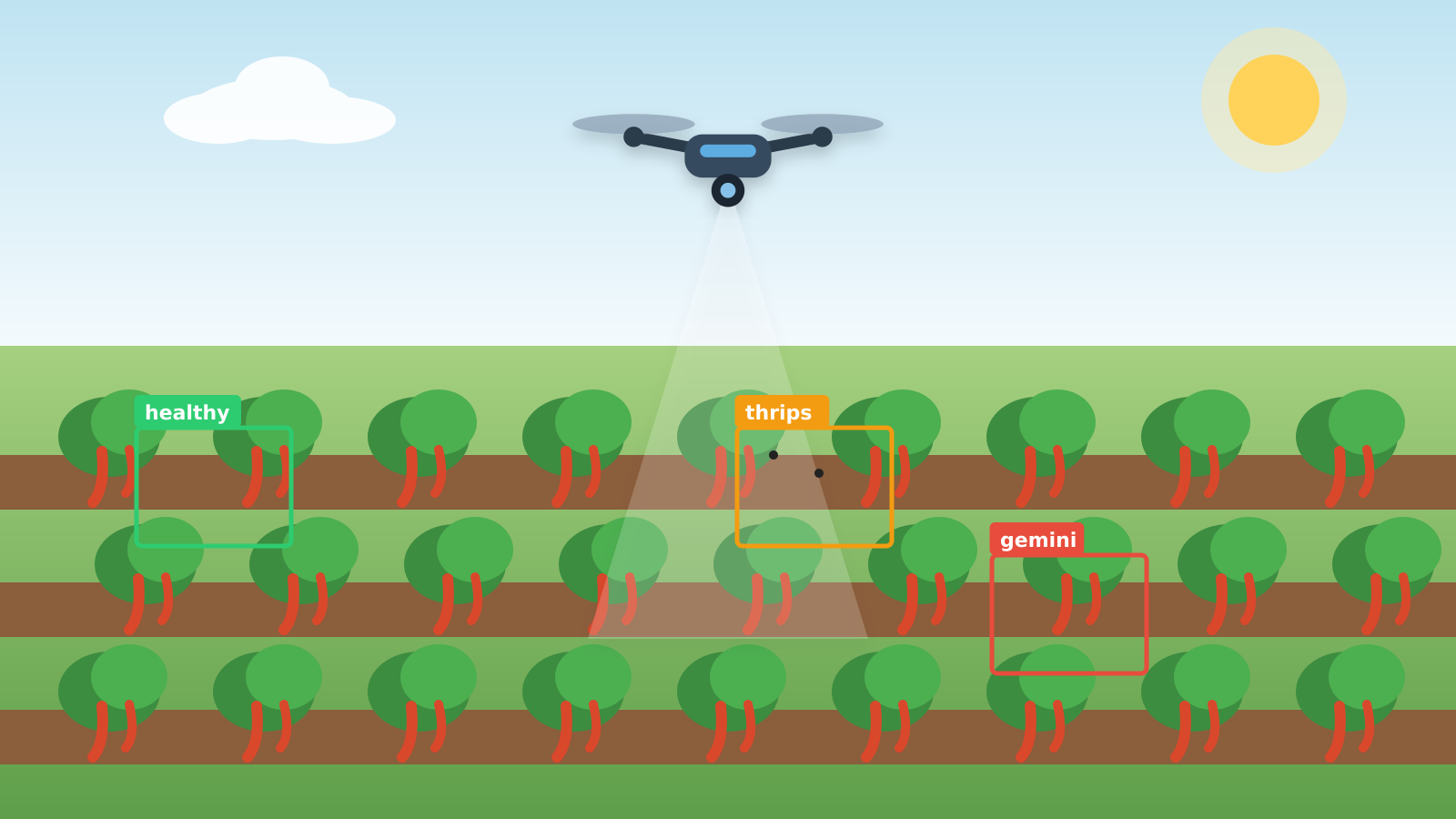
For chili farmers, a field can go from healthy to struggling very quickly. Diseases such as the Gemini virus and pests such as thrips can cause severe losses, and checking plants by hand across a whole field is slow, subjective, and hard to scale. By the time a problem is noticed on foot, it may already have spread to many plants.
Drones offer a way to look at many plants at once, but they bring a new challenge. From above, thrips and early disease symptoms are tiny objects in a cluttered outdoor scene full of leaves, soil, and shadows. Lightweight models, which are the kind that can realistically run on practical equipment, find these small targets hard to pick out. This study aims to make a lightweight model better at exactly that task.
The researchers improved a Single Shot MultiBox Detector with a MobileNetV3 backbone, a compact design that was chosen to stay light. Two additions help it see better. A Feature Pyramid Network lets the model detect objects of different sizes by combining information from several levels of detail, which is especially useful for small targets. A Convolutional Block Attention Module helps the model focus on what matters and ignore background noise. The model was trained and tested on drone images taken at 3 and 5 meters, sorted into three classes: Healthy, Thrips, and Gemini.
The improved model roughly doubled the baseline’s mAP at IoU 0.50, from 0.33 to 0.66, while still running at about 64.53 frames per second. The authors conclude that combining the two additions is an effective way to detect small pests and diseases in complex farm settings, and that the speed leaves room for real-time monitoring.
This work connects to Sustainable Development Goal 2 (SDG 2): Zero Hunger. Finding disease and pests early across a field is one way to protect the harvest before the losses add up, and that helps keep food production steady for farmers and consumers alike.
Ultimately, this study shows that a model does not need to be big to see small things. With the right additions, a compact detector can help farmers spot trouble in the chili field long before it becomes a crisis.
Metadata:
Judul article: Optimization SSD Using MobileNetV3-CBAM-FPN to Improve Chili Plant Disease Classification
Nama jurnal: International Conference on Educational Technology Management (ICETM)
Penerbit: IEEE
Tanggal publish: May 2026
Tautan / Link: https://doi.org/10.1109/icetm68138.2026.11648114
Contact:
Prof. Dr. Ir. Indrabayu, S.T., M.T., M.Bus.Sys., IPM., ASEAN.Eng
0811447755
indrabayu@unhas.ac.id