Before the Canopy Declines: Spotting an Emerging Palm Fungus with Computer Vision
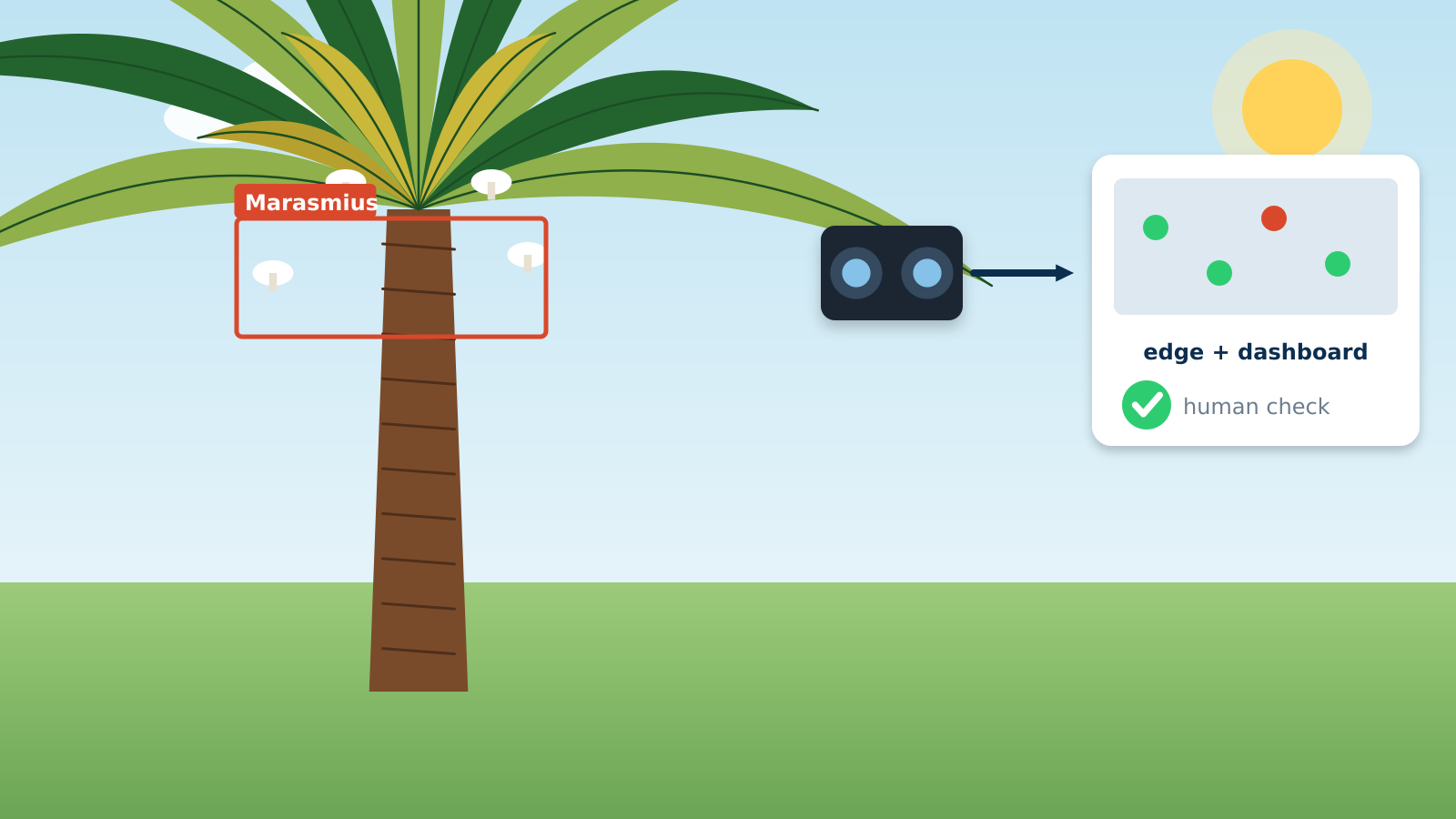
Not every threat to an oil palm plantation is well known. Marasmius palmivorus is an emerging fungus that slowly weakens the canopy and cuts yield. Because the disease is recognized late, field coverage is limited, and conditions differ from one plot to another, the response is mostly reactive: growers act only after the damage is already visible. By then, the canopy has often declined and the loss has already happened.
This research builds a detection framework on YOLOv12 to change that pattern. The team captured video in the field with binocular-assisted acquisition, and they deliberately covered uneven lighting, canopy occlusion, and cluttered backgrounds. This was a conscious choice, because those are exactly the conditions a real system has to face. A model that is only tested on clean, well-lit images may look impressive in a paper but fail on a real plantation.
To handle the uneven lighting, the researchers tested image normalization with Single-Scale Retinex, a technique that balances the brightness of an image, and an improved variant called ISSR. ISSR made detection more consistent under uneven lighting, as measured by mAP@50-95 and a stability analysis, without making the model more complex. This matters because a better result that comes with a heavier model would be harder to use in the field.
The study also goes beyond the model itself. It proposes a deployment design in which detection runs close to where the video is captured (edge inference), results are collected on central dashboards, and humans verify the findings before action is taken. The framework then connects what the model sees to specific mitigation decisions, so that a detection is not just a box on an image but a starting point for deciding what to do next.
This work connects to Sustainable Development Goal 8 (SDG 8): Decent Work and Economic Growth. Catching a canopy disease earlier moves plantation care from reacting to damage toward preventing it, which helps protect both yields and the income of the people who rely on them.
Ultimately, this study shows that a useful computer vision system is more than an accurate model. It is a complete workflow, from the field camera to the decision, designed around the real conditions of the plantation and the people who work there.
Metadata:
Judul article: Computer Vision-Driven Mitigation of Marasmius Palmivorus in Oil Palm Plantations
Nama jurnal: International Conference on Current Research in Artificial Intelligence and Data Science (ICCRAIDS)
Penerbit: IEEE
Tanggal publish: April 2026
Tautan / Link: https://doi.org/10.1109/iccraids67816.2026.11519731
Contact:
Prof. Dr. Ir. Indrabayu, S.T., M.T., M.Bus.Sys., IPM., ASEAN.Eng
0811447755
indrabayu@unhas.ac.id