Tracking a Silent Threat: A Digital Twin to Detect and Predict the Spread of Palm Stem Rot
Basal Stem Rot is one of the most serious threats to oil palm. It is caused by a soil fungus, Ganoderma boninense, and it hides well: in the early stage of infection, the tree often looks fine from the outside. The disease also moves quietly from one tree to the next through root contact, which makes it very difficult to contain once it has taken hold in a plantation.
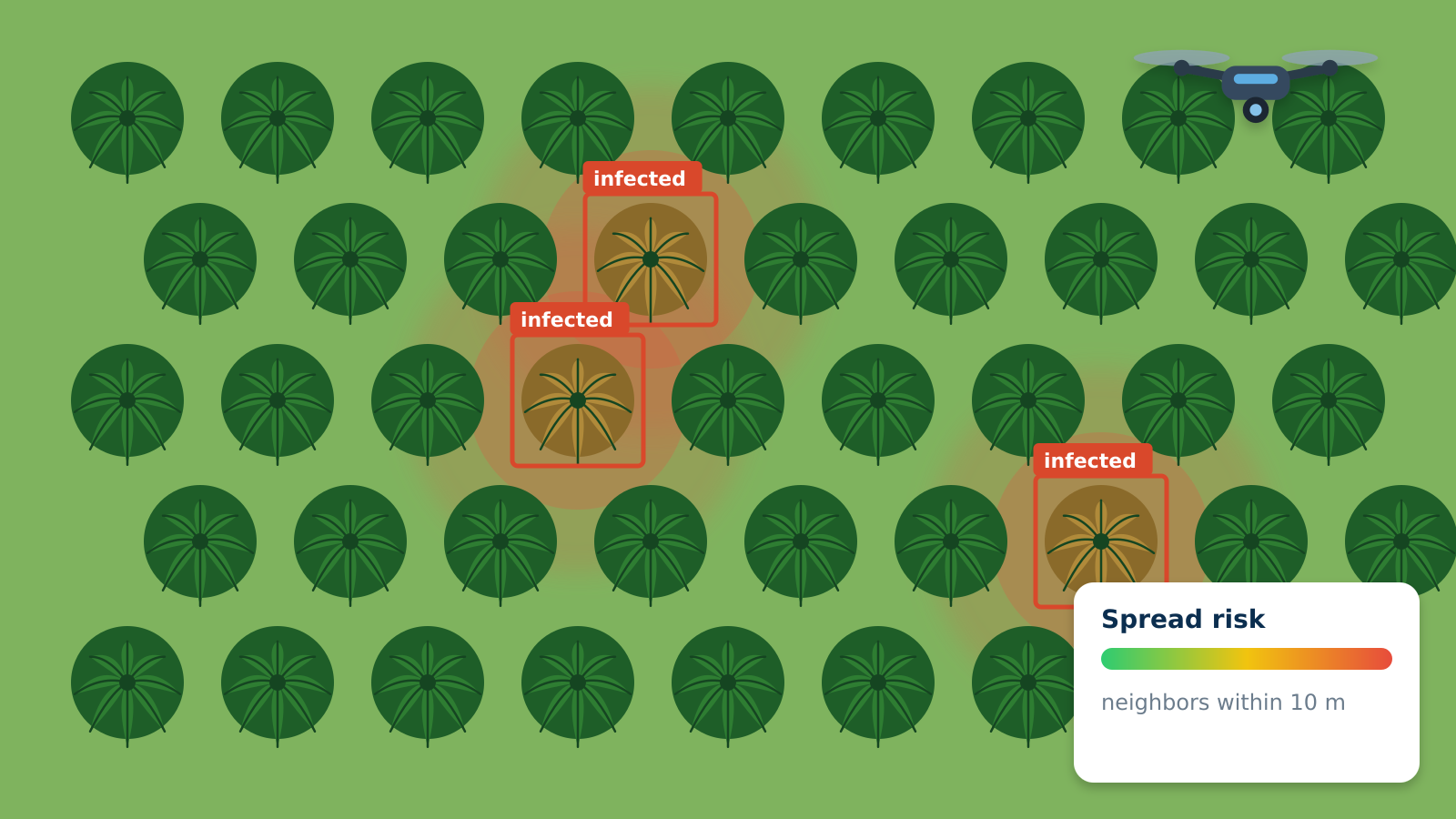
Deep learning can already spot infected palms in drone images, but most studies stop there. They tell you which tree is sick, not where the disease is likely to go next. For a plantation manager, the second question is just as important as the first, because it decides which healthy trees need protection. This study adds that missing piece by combining detection with spread modeling.
The team combined two components. YOLOv8 looks at the drone images and separates healthy palms from infected ones. A framework called AST-DSRA then takes these results and estimates how risky each neighborhood of trees is, using the distances between them. The images were taken by drone at 30 meters above the canopy in a plantation in Kubu Raya Regency, West Kalimantan. The risk model uses a 10 meter threshold, which matches standard plantation spacing, so trees that are close enough to infect one another are treated as connected.
Together, the two parts form a digital twin of the plantation, a virtual copy that does not just show the present state of the trees but can also indicate where infection may spread. According to the authors, this combination reveals infection hotspots that visual detection alone cannot show. The result is an interpretable framework, meaning that managers can understand why an area is flagged as risky, and it is practical for monitoring large plantations.
This work connects to Sustainable Development Goal 8 (SDG 8): Decent Work and Economic Growth. Knowing where a disease is heading, and not only where it is now, gives plantation managers more time to protect the trees that growers depend on for their income. Acting before the infection arrives is far less costly than responding after a tree is lost.
Ultimately, this research shows how artificial intelligence can move from simply describing a problem to helping anticipate it. A virtual copy of the plantation gives growers a way to see a silent threat before it becomes a visible one.
Metadata:
Judul article: Integration of YOLOv8 and AST-DSRA for UAV-Based Detection and Spread Modeling of Ganoderma in Oil Palm
Nama jurnal: International Conference on Information Technology Research and Innovation (ICITRI)
Penerbit: IEEE
Tanggal publish: September 2026
Tautan / Link: https://doi.org/10.1109/icitri71999.2026.11751055
Contact:
Prof. Dr. Ir. Indrabayu, S.T., M.T., M.Bus.Sys., IPM., ASEAN.Eng
0811447755
indrabayu@unhas.ac.id