Finding the Bunch Behind the Frond: Helping Drones See Partly Hidden Palm Fruit
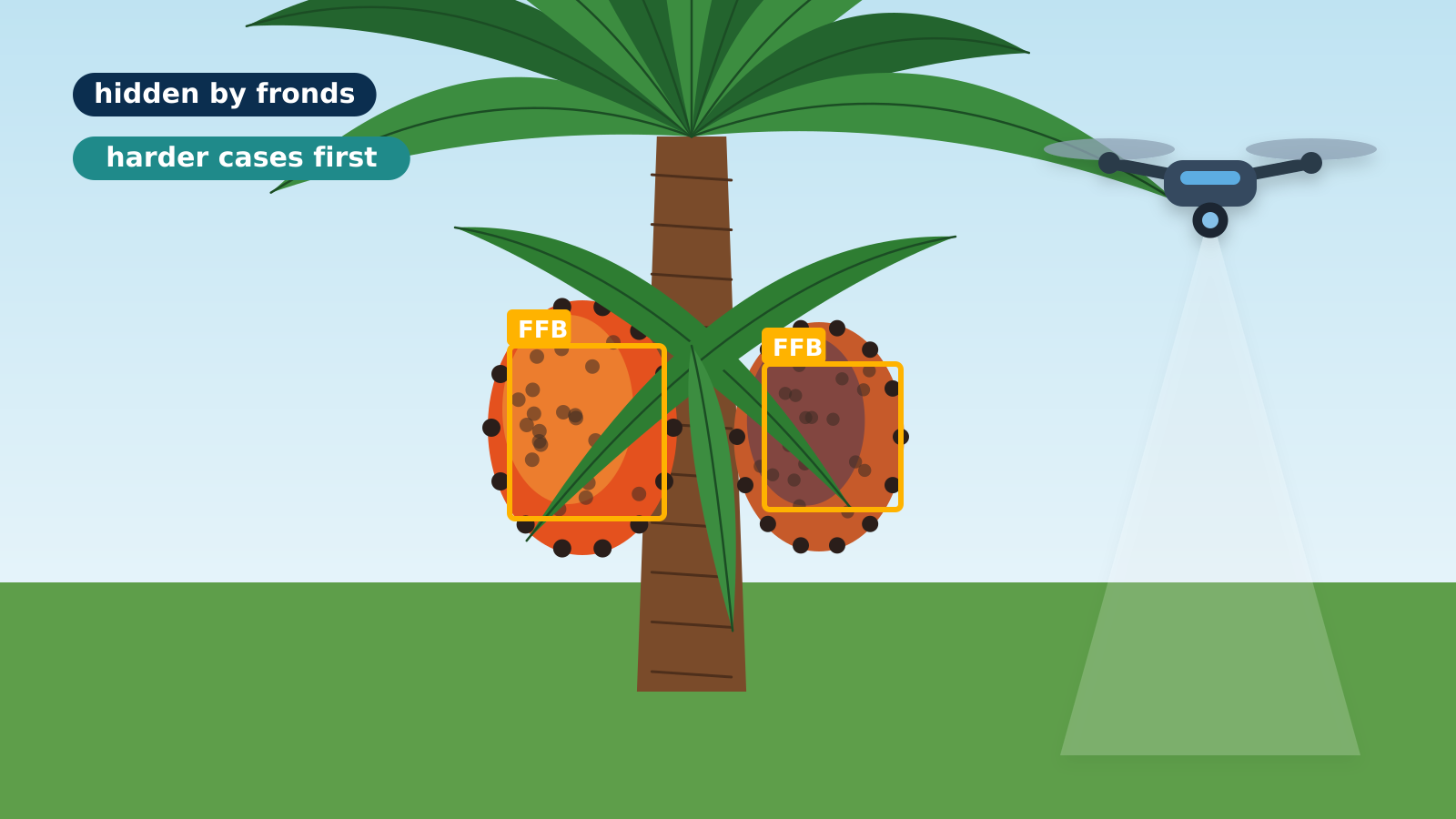
Anyone who has looked up at an oil palm knows that a fruit bunch is rarely sitting out in the open. Long fronds sweep across it, and neighboring bunches crowd against it. For a drone camera looking down from above, this means a bunch is often only partly visible. A partly visible bunch is easy to miss, or to label wrongly, and that makes automatic monitoring of the plantation less reliable than it should be.
This study tackles the problem by changing how a detector learns, rather than only changing what the detector looks like. The researchers added a technique called Loss Rank Mining to YOLOv11. During training, the model is constantly scored on how wrong its predictions are, and this score is known as the loss. Loss Rank Mining directs attention to the examples with the higher loss, in other words the ones the model handles worst. These examples include bunches that are partly hidden behind fronds or other fruit.
The idea is similar to how a student prepares for an exam. A student who only practices easy questions will feel confident but may struggle when a hard question appears. A student who deliberately spends extra time on the problems they get wrong is better prepared for whatever the exam brings. In the same way, a model that practices on difficult cases during training is better prepared for the cluttered, overlapping scenes it will face in a real plantation.
The resulting model, named YOLOv11-LRM, was compared with other YOLOv11 variants and came out ahead, reaching 99.2% mAP50 and 85.6% mAP50-95. The second number is a stricter test of how precisely the bunches are located, so a high score there is meaningful. The authors conclude that the approach holds up well under challenging agricultural conditions and is well suited to monitoring fresh fruit bunches from the air.
This work connects to Sustainable Development Goal 8 (SDG 8): Decent Work and Economic Growth. Palm oil is a livelihood for many farming communities, and a bunch that goes undetected is a harvest decision made with incomplete information. Detection that still works when the fruit is partly hidden supports more reliable monitoring, and therefore better decisions about when and where to harvest.
In the end, this research reminds us that the hardest examples are often the most valuable ones to learn from. By teaching a model to take on the difficult cases, drone-based monitoring becomes more dependable in the real conditions of the plantation.
Metadata:
Judul article: A Hybrid Approach for Handling Occlusion in UAV Images of Fresh Oil Palm Fruit Bunches Based on Computer Vision
Nama jurnal: International Seminar on Intelligent Technology and Its Applications (ISITIA)
Penerbit: IEEE
Tanggal publish: July 2025
Tautan / Link: https://doi.org/10.1109/isitia66279.2025.11137494
Contact:
Prof. Dr. Ir. Indrabayu, S.T., M.T., M.Bus.Sys., IPM., ASEAN.Eng
0811447755
indrabayu@unhas.ac.id