Lighter Eyes for the Plantation: Shrinking a Fruit Bunch Detector for Small Devices
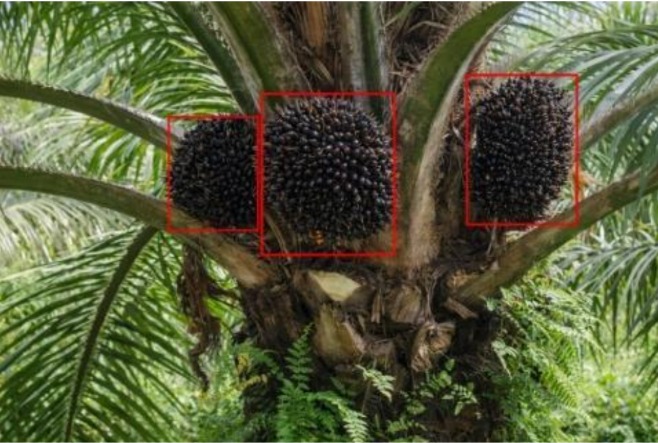
A drone can fly over an oil palm plantation and survey thousands of trees in a fraction of the time it would take a person walking between the rows. The catch is that the software which actually spots the fruit bunches in those images usually demands a powerful computer. In the field, where the hardware has to be small and the battery is limited, that requirement becomes a real obstacle. A detection model that is accurate but too heavy to carry along does very little to help the people who are doing the harvest.
This study set out to solve that problem by slimming down a YOLOv11s detector without losing what it can do. The researchers began by studying how large the fruit bunches usually appear in the images. Based on that analysis, they removed the parts of the detection path that contribute very little, a step known as structured detection-path pruning. They then compressed the model even further by converting its internal numbers to 8-bit integers, a step called INT8 quantization.
In plain English, think of the original model as a large team in which some members rarely have anything useful to do. A detector examines an image at several levels of detail, and some of those levels matter little when the objects of interest are mostly a similar size. Pruning removes the parts that add the least, so the model has less to calculate. Quantization works differently: instead of storing every number with high precision, the model keeps them in a much smaller 8-bit form. This makes the model smaller and quicker to run, which is exactly what low-power devices need.
The results show that the trade-off worked. The pruning cut the computational load by 53.5%, while the detection score (mAP@0.5) stayed at 0.987. After compression, the model ran at 30.42 frames per second on an NVIDIA Jetson Orin Nano, a small board designed for edge computing. That is fast enough for live video, which means fruit bunches can be detected in real time on low-cost hardware instead of being sent to a remote data center for processing.
This work connects to Sustainable Development Goal 9 (SDG 9): Industry, Innovation and Infrastructure. Making a detection model light enough to run on small devices is a practical way of bringing precision agriculture tools closer to the people who actually work in the plantation. It also shows that innovation does not always mean building something bigger; sometimes it means making a capable tool lean enough to be used where it is needed.
Ultimately, this research shows that a smart model does not have to be a heavy one. By trimming what is unnecessary and keeping what matters, the team has moved plantation monitoring a step closer to running on the equipment that growers can realistically carry into the field.
Metadata:
Judul article: Efficient YOLOv11-Based Oil Palm Fresh Fruit Bunch Detection Using Structured Detection-Path Pruning and INT8 Quantization
Nama jurnal: International Journal of Engineering and Technology Innovation (IJETI)
Penerbit: Taiwan Association of Engineering and Technology Innovation
Tanggal publish: August 2026
Tautan / Link: https://doi.org/10.46604/ijeti.2026.16411
Contact:
Prof. Dr. Ir. Indrabayu, S.T., M.T., M.Bus.Sys., IPM., ASEAN.Eng
0811447755
indrabayu@unhas.ac.id