
Makassar, Indonesia, March 5, 2026/AquEcotox/ – Lakes often appear calm and silent, reflecting the sky like natural mirrors. Yet beneath that quiet surface, complex ecological processes are constantly taking place. When scientists carefully observe these processes, a lake can reveal important messages about environmental change, human activity, and the future of freshwater ecosystems. One such story emerges from Lake Balang Tonjong in Makassar, South Sulawesi.
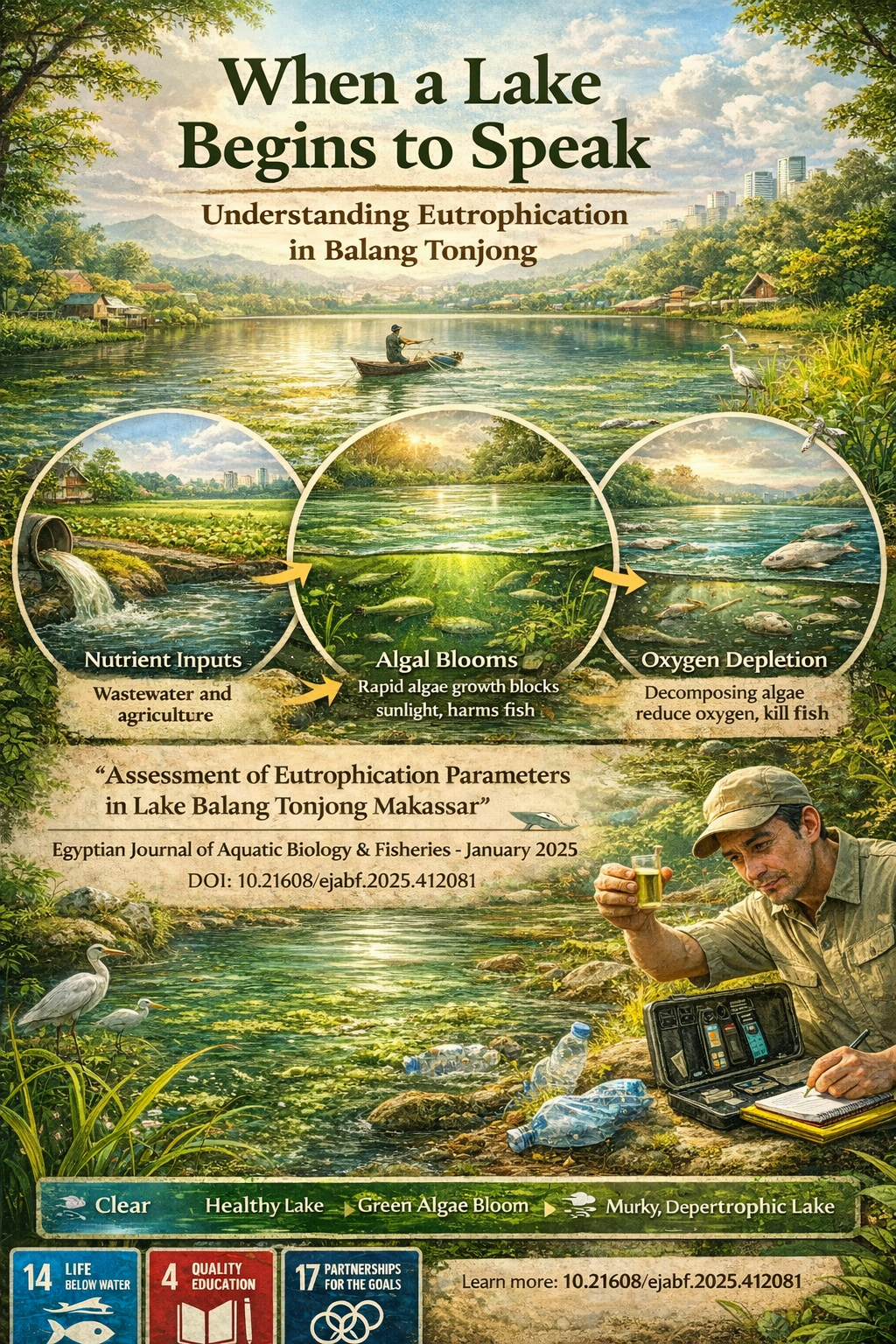
Freshwater lakes are essential for human life. They support fisheries, supply water for communities, sustain biodiversity, and regulate local climate. However, many lakes around the world face a growing environmental problem known as eutrophication. This condition occurs when excessive nutrients—mainly nitrogen and phosphorus—enter a water body, often from domestic waste, agricultural runoff, or urban development. When nutrient levels rise too high, algae and aquatic plants grow rapidly, disturbing the natural balance of the ecosystem.
Eutrophication is more than just an ecological issue. It can reduce oxygen levels in the water, harm fish populations, degrade water quality, and threaten the livelihoods of communities that depend on aquatic resources. Because of these risks, scientists increasingly monitor lakes to detect early signs of nutrient enrichment.
An important scientific study recently examined this issue in Lake Balang Tonjong. The research titled Assessment of Eutrophication Parameters in Lake Balang Tonjong Makassar was published in the Egyptian Journal of Aquatic Biology and Fisheries, a journal issued by the Egyptian Society for the Development of Fisheries and Human Health (ESDFHH), and released in January 2025. The study carefully evaluates key indicators of eutrophication in the lake, including nutrient concentrations and ecological conditions that influence algal growth.
Monitoring eutrophication parameters is crucial because it allows scientists to understand whether a lake remains healthy or is gradually moving toward ecological imbalance. When nutrient levels increase beyond natural limits, algal blooms may appear more frequently. These blooms can reduce water clarity and eventually decrease dissolved oxygen levels, creating stressful conditions for fish and other aquatic organisms.
Research like this is not only valuable for scientists. It also provides practical information for policymakers, environmental managers, and local communities. By understanding how nutrient inputs affect lake ecosystems, stakeholders can design better strategies to manage wastewater, reduce pollution, and protect freshwater resources.
The significance of this research can also be seen through the lens of the global Sustainable Development Goals. In particular, it supports Sustainable Development Goal (SDG) 14: Life Below Water, which emphasizes the protection and sustainable management of aquatic ecosystems. Although SDG 14 is often associated with oceans, freshwater lakes play an equally important role in maintaining aquatic biodiversity and ecological stability.
At the same time, studies like this contribute to SDG 4: Quality Education, because scientific knowledge helps societies understand environmental challenges through evidence-based learning. In addition, international scientific publication and collaboration reflect SDG 17: Partnerships for the Goals, highlighting how research communities across countries work together to advance environmental science.
Lake Balang Tonjong reminds us that freshwater ecosystems are living systems that respond to human activities. When carefully studied, they provide valuable signals about environmental change. By listening to these signals and acting responsibly, societies can protect lakes not only as natural landscapes, but also as vital resources for future generations.
Readers interested in the scientific foundation of this discussion can access the original article through the
DOI Reference: 0.21608/ejabf.2025.412081
Contact
Prof. Dr. Ir. Khusnul Yaqin, M.Sc
+6285691546955
khusnul@unhas.ac.id