
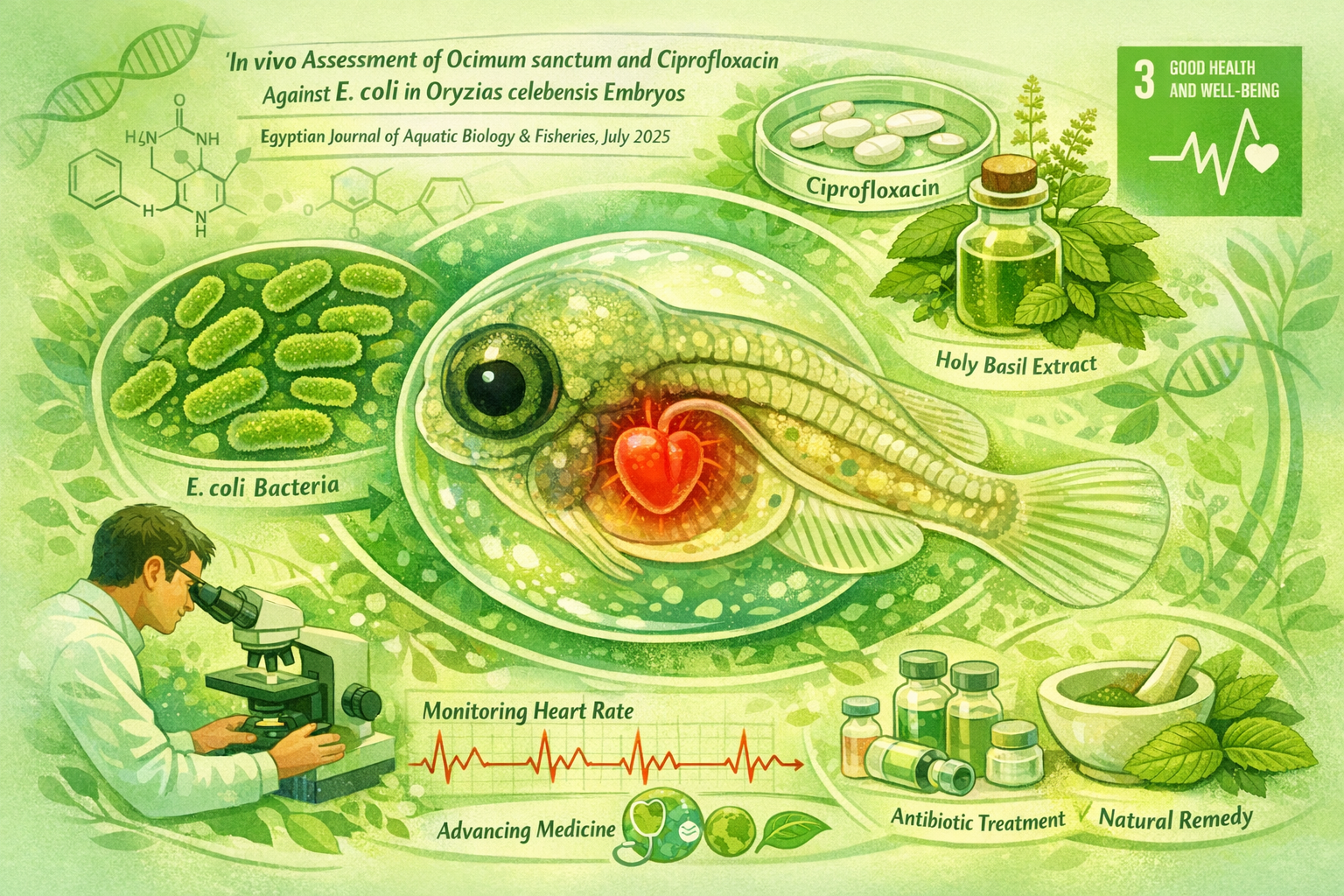
Makassar, Indonesia, March 5, 2026/AquEcotox/ – In the search for new ways to combat harmful bacteria, scientists are increasingly turning to unexpected allies in nature. One such ally is a small freshwater fish native to Indonesia known as the Celebes medaka (Oryzias celebensis). Although this species lives quietly in tropical waters, it has become an important model organism for understanding how living systems respond to infection and treatment. Remarkably, even the heartbeat of its developing embryos can reveal valuable insights into biological stress and recovery.
Modern medicine faces a growing challenge: bacterial infections that become resistant to antibiotics. While pharmaceutical drugs remain essential tools, researchers are also exploring natural compounds that may complement conventional treatments. Plants long used in traditional medicine are particularly interesting because they contain bioactive molecules with antimicrobial properties. Among these plants, Ocimum sanctum, commonly known as holy basil, has attracted scientific attention due to its potential health benefits.
This innovative approach is explored in a scientific study titled “In vivo Assessment of Ocimum sanctum and Ciprofloxacin Against Escherichia coli in Oryzias celebensis Embryos Using Heart Rate as a Non-Destructive Biomarker.” The research was published in the Egyptian Journal of Aquatic Biology and Fisheries, issued by The Egyptian Society for the Development of Fisheries and Human Health (ESDFHH) in July 2025. The study investigates how both a natural plant extract and a well-known antibiotic, ciprofloxacin, influence bacterial infection and physiological stress in developing fish embryos.
The research focuses on Escherichia coli, a bacterium that can cause infections in both humans and animals. By introducing the bacteria into Oryzias celebensis embryos, scientists created a controlled biological model to observe how the infection affects the developing organism. Instead of harming the embryos to measure internal responses, the researchers used a non-destructive biomarker: the heart rate.
Fish embryos offer a unique advantage in this type of study. During early development, their bodies are transparent, allowing researchers to observe internal processes directly under a microscope. Changes in heart rhythm can indicate physiological stress, infection, or recovery. When treatments such as ciprofloxacin or Ocimum sanctum extract are introduced, scientists can monitor how the heartbeat responds, providing a clear signal of biological impact.
The findings suggest that both natural and pharmaceutical treatments can influence how organisms respond to bacterial infection. Such insights may help scientists develop more balanced strategies that integrate modern medicine with natural bioactive compounds. This approach reflects a growing global interest in sustainable health solutions that combine scientific innovation with knowledge derived from nature.
The broader significance of this research connects strongly with SDG 3: Good Health and Well-Being, one of the United Nations Sustainable Development Goals. SDG 3 emphasizes the importance of advancing medical knowledge, improving disease prevention, and ensuring healthier lives for people worldwide. Research that explores new ways to understand infection and treatment contributes directly to this global mission.
Beyond medicine, the study also demonstrates how aquatic organisms can serve as powerful tools for biomedical and environmental research. By using non-invasive methods such as embryo heart rate monitoring, scientists can reduce harm to research organisms while still obtaining valuable biological data. This approach reflects a modern scientific philosophy that values both ethical research practices and innovative methodology.
In essence, the gentle rhythm of a developing fish embryo carries a powerful message. Within each heartbeat lies a signal that helps scientists understand infection, evaluate treatments, and explore new possibilities for protecting human and environmental health.
Reference:
10.21608/ejabf.2025.446902
Contact:
Prof. Dr. Ir. Khusnul Yaqin, M.Sc
+6285691546955
khusnul@unhas.ac.id